Life after lockdown: How Bulgari's head honchos plan to reconquer the world
Advertisement
People
Life after lockdown: How Bulgari's head honchos plan to reconquer the world
Bulgari'south artistic director Lucia Silvestri and CEO Jean-Christophe Babin share their experiences in lockdown, every bit well as how they intend to navigate a post-pandemic earth.
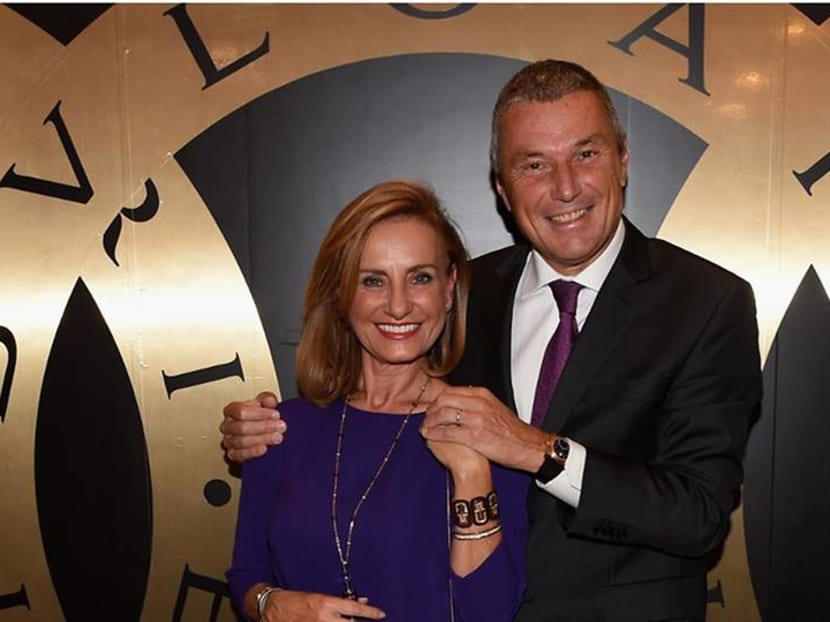
Lucia Silvestri and Jean-Christophe Babin. (Photograph: Getty Images/AFP/Jamie McCarthy)
Bulgari'due south creative director Lucia Silvestri said she felt "rather like a tiger in a cage" during Italy'southward strict lockdown to curtail the march of coronavirus. She has been grounded in Rome since March.
"I miss my trips a lot," she said. "I love to travel and I miss my previous life." Information technology was a peripatetic existence, typically travelling on alternate weeks from the Italian capital to the likes of Jaipur, Bangkok and New York.
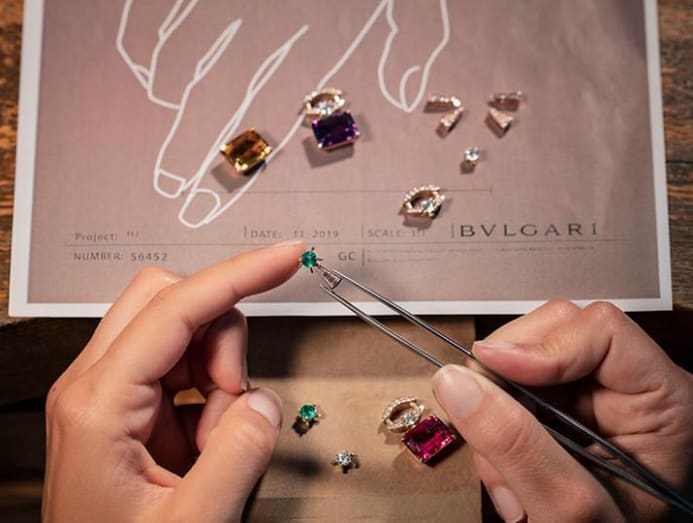
Her mission: Sourcing and acquiring the colourful cabochon stones – from pinkish tourmaline to blue chalcedony – that take become the hallmark of the architectural designs by the quintessentially Roman jeweller.
READ> Roman jeweller Bulgari launches Singapore online store alee of Italy
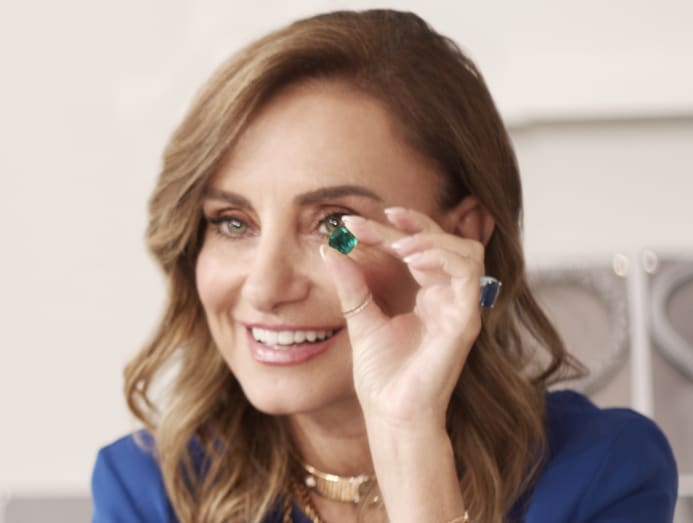
Instead, Silvestri, whose own career at the LVMH-owned maison began over iv decades ago, has conducted an endless stream of video meetings from her dwelling house during the pandemic. In just one case of the new paradigm, the day before we speak she assessed the cut of a 45ct emerald over Zoom, negotiating with a supplier in Jaipur, Rajasthan'south Pink City.
"Information technology was interesting, but of class it's not the same," she said. In the daily calls with her team, "we share our ideas, our sensations, our suggestions. The simply thing I miss is the physical arroyo. I need to sketch in front of the squad and requite some suggestions – this is a little flake hard. But the creativity is very strong."
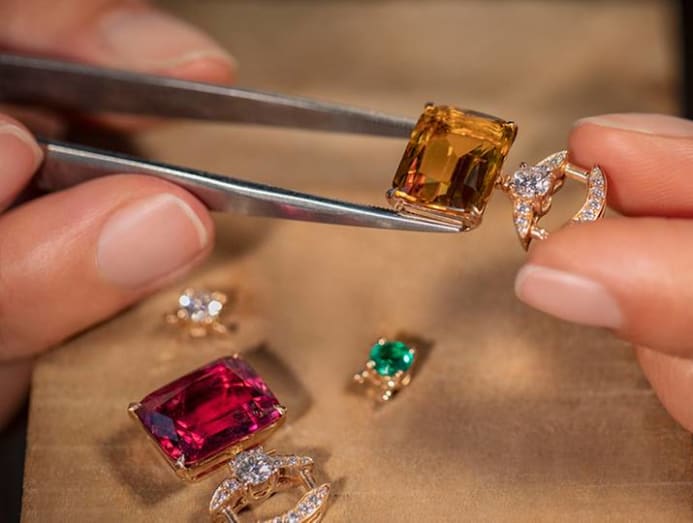
If the long gem table in Bulgari's office is Silvestri's blank canvas, then the stones are her paint. "Everything starts from the gems." She talks to them, absorbs their free energy and gazes at them for hours – seeing "gardens within emeralds" and "fire within rubies". She arranges the stones on trays filled with wax and experiments with different shapes and colour combinations before the designs are sketched then sent out to be made in the workshops.
It is this instinctual affinity with gems that first captured the attention of Paolo Bulgari, the grandson of the brand'due south founder Sotirios Voulgaris (later Italianised to Bulgari), a Greek silversmith who arrived in Rome in 1881.
Every bit an 18-twelvemonth-old biology pupil, Silvestri took a temporary position at Bulgari covering a maternity leave – and never left. She was introduced to the company past her male parent, who had worked with the Bulgari family unit. At that stage, information technology was run by the founder's three grandsons: Gianni, Paolo and Nicola.
READ> What sparks joy in troubled times? Vivid colours and a sense of exuberance
She began caressing the semi-precious stones and playing with unlike combinations: Tourmaline and peridot, amethyst and aquamarine. "I really fell in love with the gems," she said.
It was a insurrection de foudre. Silvestri threw in her studies and began to work full-time for Bulgari in its gemological department. "I was the correct person at the right time," she said. The three grandsons were looking to bring on a younger person whom they could train to follow in their footsteps.
They adopted Silvestri every bit their protegee and soon she followed them effectually the world, learning how to source, cut and adapt gems, and about colour, beauty and proportion. She later joined the purchasing department and progressed upward the arrangement.
Eventually, following Bulgari'southward conquering by LVMH, Silvestri was promoted to creative director of jewellery and loftier jewellery in 2013. She likes to say that, such is her passion for gems, she must have been an Indian maharani in a previous life.
The by decade has been ane of transformation for Bulgari's business. In March 2022 it was bought by LVMH, the world's largest luxury grouping past revenues, for €iv.3 billion (South$6.76 billion at today'due south rate), a 60 per cent premium to its share price. The acquisition doubled LVMH's size in "difficult" luxury – watches and jewellery – and marked a sign of its ambition to take on Johann Rupert's Swiss conglomerate Richemont, the dominant player in the category and owner of Cartier and Van Cleef & Arpels.
LVMH does not publicly give a breakup of the functioning of individual brands in its empire. However, the grouping's watches and jewellery division, in which Bulgari is the largest brand, grew sales more than than fourfold from €985 million at the end of 2010 (only earlier the Bulgari acquisition) to €four.4 billion at the cease of 2019. Meanwhile, the division'due south profits from recurring operations accept surged from €128 million to €736 million during the aforementioned menses.
"I run into COVID-19 . . . as a parentheses and not a crisis… every bit presently every bit nosotros reopened the stores – and the Chinese numbers are clear – people have rushed back to the malls and restarted buying Bulgari every bit they did earlier." – Jean-Christophe Babin
If all goes to plan, Bulgari will before long be joined at LVMH past another iconic jeweller: Tiffany.
In November, LVMH agreed to purchase the US brand, known for its robin'south-egg-blue boxes, diamond engagement rings and starring function in Truman Capote's novella-turned-flick Breakfast at Tiffany's. At an agreed toll of US$16.six billion (Due south$23 billion), the acquisition would, if it is completed, marking the largest-ever luxury bargain. It would double LVMH's market share in jewellery, and further cement the group'south authority in the overall luxury sector.
Analysts and investors are at present looking to the Bulgari playbook under LVMH's ownership for clues equally to how Tiffany may fare if it becomes part of Bernard Arnault'south group. Despite stiff make recognition, the U.s. jeweller has lost its lustre in recent years and suffered from a combination of weak tourist spending, a potent dollar and declining footfall in its stores.
When Bulgari changed ownership back in 2011, it was not a dissimilar story. It had suffered from declining sales since the mid-2000s, and the business was fragmented across iv divisions: Jewellery, watches, perfume and accessories.
"This slowdown was pretty much driven by probably as well much diversification in a besides short space of time, eventually cornering the cadre business – jewellery – into an angle where information technology became invisible," said Babin, who is speaking past video link from the company's Swiss headquarters in Neuchatel, from where he has been running the business during lockdown. "This non only provoked a slowdown of the entire company, but besides some confusion as to what Bulgari stood for."
This informed the conclusion to refocus the brand on Bulgari'southward raison d'etre: "a magnificent and gimmicky Roman jeweller", said Babin. It shifted the emphasis away from accessories, fragrances and male watches and on to jewellery and women's watches, in everything from advert to the layout of its stores.
Babin said: "We restarted growing very quickly, and jewellery and ladies' watches not but became the engine of growth merely the large majority of our business organization."
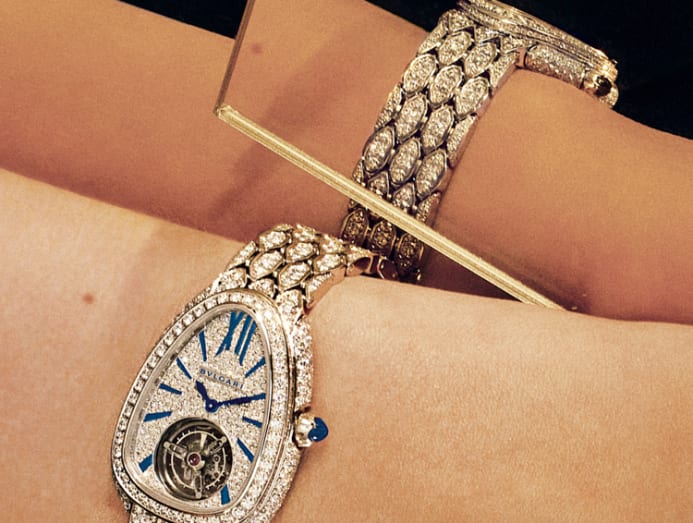
From a creative point of view, Bulgari homed in on its Roman heritage and its signature motifs, personified in the reptilian scales and snake heads of Serpenti, the antique Roman coins of Monete, and the B.zero1 collection, which is inspired by the circularity of Rome's Colosseum.
Serpenti was propelled to cult status past the late extra Elizabeth Taylor later on she was photographed wearing a gold-and-diamond coiled serpent lookout man past Bulgari when she was filming Cleopatra in Rome in 1962.
She later wrote in her memoir, My Love Affair with Jewellery, that "one of the biggest advantages to working on Cleopatra in Rome was Bulgari'southward nice petty shop" – at via dei Condotti 10, near the Castilian Steps – and fondly recalls afternoons swapping stories with Gianni Bulgari.
Under LVMH'southward ownership, high jewellery – the metier'southward equivalent of haute couture – was expanded by adding new collections that drew on Bulgari's Roman heritage. Divas' Dream, whose signature fan motif was inspired by the Baths at Caracalla, launched in 2013; and Fiorever, which combines bloom petals and diamonds, was unveiled in 2022 every bit "an emblem of the Roman passion for life".
Meanwhile, peripheral businesses such as perfume and accessories were realigned in order to reinforce rather than dilute the brand, using the major motifs to drive design in these categories. Now, when you lot go into a Bulgari store, "at that place is a very immediate thread design-wise, which connects the categories together", said Babin.
In the past few years, Bulgari, similar other luxury brands, has sought to target a younger audience and has changed the profile of its make ambassadors to assist practice so. Model and singer Carla Bruni-Sarkozy (then in her forties) was the face of Bulgari in 2013; this twelvemonth the company named a group of millennials – Zendaya, Lily Aldride, Kris Wu and Naomi Scott – as its ambassadors.
"This is a clear message from Bulgari to its potential clients that nosotros are not merely the high jeweller for wealthy middle-aged people," said Babin.
Under LVMH's ownership, Bulgari has more than than tripled profits, according to analysts. Babin declined to comment on this, saying only that in its cadre business of jewellery, profitability is "very close to our criterion competitors" – Richemont's Cartier and Van Cleef & Arpels – "which have critical sizes which are still twice as big as Bulgari'due south".
Margins have increased for 3 chief reasons, he said: The brand has cut back on expensive materials such as gold and platinum, increased prices in line with or even above those of competitors, and benefited from economies of scale as sales grew.
Just as LVMH's primary fiscal officeholder Jean-Jacques Guiony said in November that "we expect to bring Tiffany time and capital", being part of a much larger empire has given Bulgari the back up to "make meliorate decisions with more remainder betwixt the short and the long term", said Babin. And information technology has also meant stronger collective bargaining ability for negotiating real estate rents for stores and malls.
From Silvestri's perspective, "LVMH left our creativity and they gave us the possibility to remain Italian." Every bit the Bulgari family has stepped back from day-to-day interest and largely sold its pale in the business, she has become more than involved with clients.
Bespoke commissions are an important office of this, and recently she has worked on a xanthous-aureate bustier encrusted with diamonds and emeralds. Another memorable committee, she recalled, was a modular necklace of pinkish tourmalines, rubies and rubellites, which turns into a tiara, with the drop becoming a pendant. It was created for a Chinese bride.
The artistic influence of the Bulgari grandsons on Silvestri is still profound. She recalled her "first big important lesson" from them: "Don't buy a stone if you don't know how yous can use it."
And while she is constantly delving into Bulgari's archives for inspiration, she also tries to live past another lesson from her mentors: "Take inspiration from the by, merely don't echo yourself. One eye is to the past and ane eye is to the future."
"Accept inspiration from the past, but don't echo yourself. One middle is to the past and one eye is to the future." – Lucia Silvestri
From a business perspective, the future looks uncertain. And so far, Bulgari, which has 320 stores globally, has not laid off any staff permanently during the coronavirus outbreak, said Babin. In Europe, its stores were airtight for an boilerplate of eight weeks at the elevation of the pandemic. Information technology has signed upward to government furlough schemes globally, which pay 20-eighty per cent of staff salaries, depending on the country.
Babin is optimistic nearly the outlook.
For Bulgari'southward core jewellery business, "I see COVID-nineteen . . . as a parentheses and not a crisis, in the sense that as shortly as we reopened the stores – and the Chinese numbers are clear – people have rushed dorsum to the malls and restarted buying Bulgari as they did before." He said that sales have been growing in double digits in China since mid-March, and May in China was "the highest month e'er in the history of the company".
Others take a more pessimistic view. Consultant Bain forecasts a decline in overall luxury sales of 20 to 35 per cent this year. Richemont's Johann Rupert warned last calendar month that COVID-nineteen volition cause "grave economical consequences" for upwardly to three years; and investors are concerned about customers' willingness to spend – the so-called "feel-expert factor" – and their ability to travel, which is a major driver of luxury goods sales.
The weeks ahead are crucial, "non just for the residuum of the year merely for 2021", said Babin. "If we manage to go on COVID-nineteen as a curt parenthesis then we should not have a recession. If conversely it lasts to the betoken where governments won't be able to support temporary lay-offs, and so yes we can take a recession."
Meanwhile, back in Rome, equally Italy slowly emerges from lockdown, Silvestri is once more able to wander the streets of the metropolis where she grew upward.
Sharing images on Instagram with her 58,000-plus followers, she captures the colours of Rome – Bulgari's original muse – in the mundane to the magnificent: Vegetable markets and cobblestone streets, the Palazzo Borghese and the Pantheon. These days spent in quarantine have only reinforced "how of import Rome is for Bulgari, for the make, and for me", said Silvestri. "Information technology's something we accept in our veins."
By Harriet Agnew © 2022 The Financial Times
READ> What does a pandemic-free future hold for the world's biggest watch fairs?

Contempo Searches
Trending Topics
Source: https://cnalifestyle.channelnewsasia.com/people/bulgari-ceo-creative-director-247821
0 Response to "Life after lockdown: How Bulgari's head honchos plan to reconquer the world"
Post a Comment